Skip to content

- Reviews
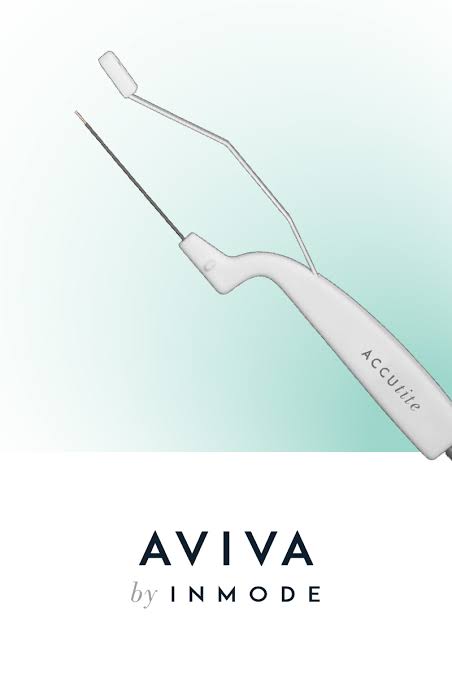
Aviva by InMode (Review)
Aviva Rating from Providers: 4.6 out of 5
Aviva Rating from Patients: 4.0 out of 5
Want to see how MBC reviews are calculated? Click here.
Review Summary
Aviva by InMode is a minimally invasive radiofrequency treatment designed for external intimate rejuvenation, including concerns related to tissue laxity, appearance, and physical discomfort.
But here’s the key insight:
Providers are considerably more enthusiastic about Aviva than the available patient experiences justify on their own.
Provider sentiment in the submitted dataset is overwhelmingly positive. The recurring appeal is straightforward: Aviva offers an option between doing nothing and undergoing surgical labiaplasty. Providers describe being able to tighten and reshape external tissue without surgical excision, while offering an in-office procedure with less downtime than surgery.
The patient experience is more nuanced.
Most patient comments are positive, but the limited number of detailed first-person reviews makes the patient rating less reliable than the provider rating. Among the substantive patient accounts, swelling, bruising, tenderness, and uncertainty during early recovery appear repeatedly. One patient also reported some tightening but ultimately underwent surgical labiaplasty because Aviva did not produce enough correction.
The result is a treatment that appears promising for the right degree of correction, but one where patient selection may matter just as much as the technology itself.
Provider Praise
(Industry sentiment from Social Media, Facebook, Instagram & Forums)
From a provider standpoint, the strongest praise centers on Aviva’s ability to provide meaningful tissue remodeling without traditional surgical excision.
Providers repeatedly described Aviva as useful for:
- addressing mild to moderate laxity
- improving aesthetic appearance without surgical incisions
- addressing discomfort associated with excess or lax tissue
- offering less downtime than traditional labiaplasty
- treating patients who want improvement but are not ready for surgery
The procedure uses radiofrequency-assisted technology to heat and contract tissue rather than surgically removing it. Several provider comments specifically positioned this as Aviva’s main advantage over traditional labiaplasty.
Another recurring strength is practicality.
The dataset describes Aviva as an in-office procedure performed under local anesthesia and generally completed in a single treatment. That potentially gives practices an option for patients seeking a more substantial intervention than completely non-invasive vaginal wellness treatments without immediately moving to surgery.
Provider Complaints
There were remarkably few negative provider comments in the submitted dataset.
That sounds like an obvious strength, but it also deserves scrutiny.
A substantial portion of the provider commentary comes from practices discussing or promoting the treatment. Statements describing Aviva as “life-changing,” “groundbreaking,” or the “best” option should therefore be treated as promotional sentiment rather than independent evidence of clinical superiority.
The more meaningful limitation appears in patient selection.
One provider specifically described Aviva as appropriate for patients without more substantial labia minora hypertrophy. That distinction matters because Aviva contracts and remodels tissue; it does not remove tissue in the same way surgical labiaplasty does.
For practices, that makes consultation especially important. Positioning Aviva as a universal substitute for labiaplasty would overstate what the available sentiment supports.
Patient Review
(Industry sentiment from Reddit, Instagram & Forums)
Patient reviews were scored independently from provider commentary using the same sentiment methodology.
Aviva Rating from Patients: 4.0 out of 5
What Patients Are Saying
Overall patient sentiment was favorable.
Patients described positive experiences and satisfaction with their treatment, and one Instagram commenter reported that her sister “can’t stop talking about how good she feels” following Aviva.
However, the detailed patient reviews reveal something that the shorter positive comments do not:
Recovery can look more dramatic than the phrase “minimal downtime” may suggest.
One patient reported significant swelling following treatment but said it was not painful. Another, only two days post-treatment, described the area as purple, very swollen, tender, and visually alarming.
These experiences do not necessarily indicate poor outcomes. They do suggest that practices should prepare patients for what the early healing period may actually look and feel like.
The other important limitation comes from a patient who reported that Aviva produced some tightening but ultimately did not provide enough correction, leading her to undergo surgical labiaplasty.
That may be one of the most useful pieces of patient feedback in the dataset.
Aviva does not necessarily fail because it doesn’t produce a surgical result. The problem arises when a patient expects one.
Cost Breakdown
The submitted dataset does not contain verified manufacturer pricing for equipment acquisition.
Provider commentary indicates that Aviva treatment pricing varies based on the treatment area, geographic location of the practice, and provider performing the procedure. However, the dataset does not contain enough consistent pricing information to establish a reliable average patient treatment price.
The available information also does not provide enough detail to reliably calculate consumable costs, maintenance expenses, treatment-level profit margins, or overall return on investment.
From the sentiment provided, the business case appears particularly dependent on appropriate patient selection and treatment positioning. Practices able to identify patients seeking meaningful improvement without surgical excision may have a clearer value proposition than practices attempting to position Aviva as a direct replacement for labiaplasty.
Final Verdict
Aviva occupies an interesting position in intimate aesthetics.
It offers more intervention than many completely non-invasive vaginal wellness treatments while avoiding the tissue excision and recovery associated with traditional labiaplasty.
Providers clearly see value in that middle ground.
But here’s where expectations matter:
Aviva can tighten and remodel tissue. It should not automatically be interpreted as a non-surgical way to achieve a surgical result.
The available patient experiences support that distinction. Some patients are highly satisfied, while another experienced only partial correction and ultimately chose surgery. Early swelling, bruising, and tenderness also appear significant enough that practices should discuss them clearly during consultation.
Best suited for: patients with mild to moderate tissue laxity or aesthetic concerns, patients experiencing physical discomfort who may benefit from tissue tightening, patients who want to avoid surgical incisions, and patients whose expectations align with remodeling rather than tissue removal.
Not ideal for: patients with more substantial tissue excess, patients expecting the same degree of correction as surgical labiaplasty, patients unwilling to tolerate temporary swelling or bruising, or practices that cannot clearly distinguish between a minimally invasive improvement and a surgical endpoint.
Overall assessment: Aviva earns a strong provider rating because the professional sentiment is overwhelmingly favorable and its clinical positioning fills a genuine gap between non-invasive treatments and surgery. The patient rating is more conservative because detailed independent patient experiences are limited and reveal meaningful variability in recovery and degree of correction. For the right patient, that middle ground may be exactly the point
Leave Your Review
Latest Reviews
There are no reviews yet. Be the first one to write one.